Buying guide
Espresso vs Coffee Buying Guide: Pick Your Brew Path
How to choose between espresso and coffee brewing: pressure explained, machine types, the grinder question, and a decision framework for every drinker.
Start with our top 3


The real decision: pressure, not beans
Espresso is a pressure method, not a bean. Around 9 bars of pressure force hot water through finely ground coffee in under 30 seconds, extracting the oils and colloids that create body and crema. Drip, pour over, French press, and moka pots all work at far lower pressure with longer contact time. That is why an espresso shot tastes syrupy and a pour over tastes clean even from the same bag. Decide which cup you want first; the equipment follows. Our espresso maker vs espresso machine explainer untangles the terminology retailers use.
The four machine types
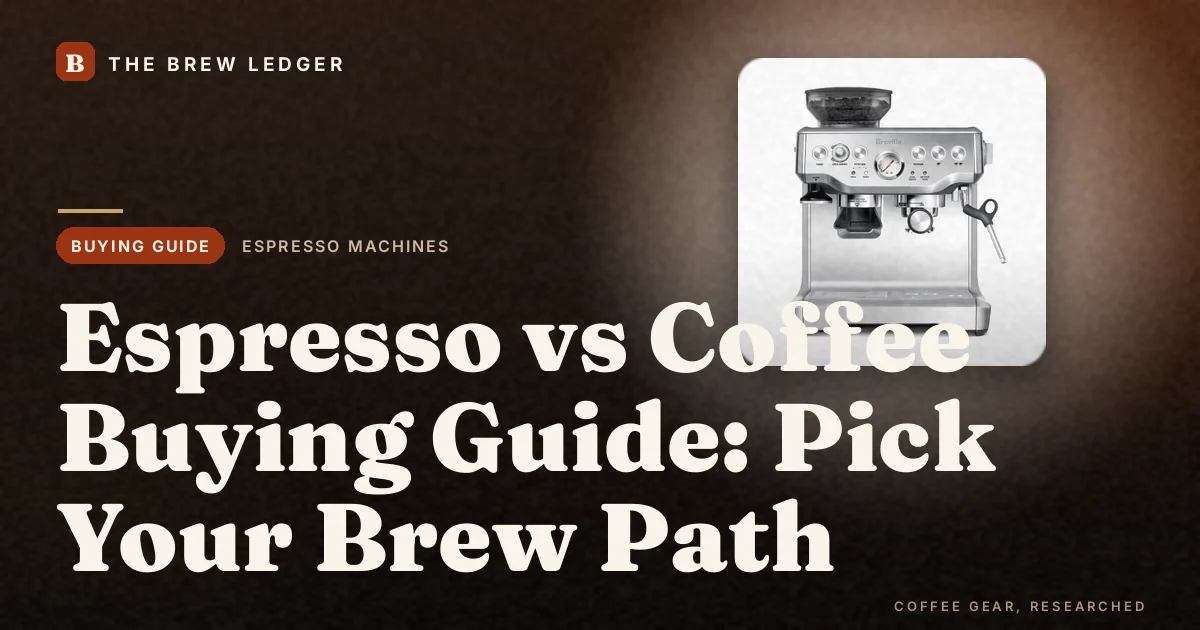
Semi-automatics like the Barista Express give you a pump, a portafilter, and control: you grind, dose, tamp, and time the shot. Super-automatics like the Magnifica Evo do all of that internally at one touch. Moka pots like the Moka Express brew strong stovetop coffee at 1.5 bars with no electricity. Pod machines like the Vertuo Plus trade bean quality for speed with barcode-read capsules. Each type is honest about its trade; the buyer's job is matching the trade to their routine.
The grinder question
For pump espresso, the grinder matters more than the machine. Stale or wrongly ground coffee ruins shots no machine can save. Built-in grinders (16 settings on the Barista Express, 13 on the Magnifica Evo) solve this in one purchase. Budget machines like the Stilosa skip the grinder, which means budgeting for a separate one or accepting pre-ground coffee's limits. For moka, pour over, and press, grind matters but the methods forgive far more. Our espresso beans vs coffee beans guide covers roast and grind matching per method.
Decision framework: which path is yours
Buy the semi-auto path (Barista Express) if: you want to learn espresso as a craft, you enjoy dialing in grind and dose, and milk drinks are a hobby not a hurry. Avoid it if: you will not spend a month pulling uneven shots while you learn, or your mornings allow no ritual at all.
Buy the super-auto path (Magnifica Evo) if: you want real espresso from fresh beans with zero technique, your household drinks several cups daily, and you will follow the descaling schedule. Avoid it if: maintenance chores go undone in your house, or you want manual control over extraction.
Buy the stovetop path (Moka Express) if: strong black coffee is your whole routine, your budget is small, and you value indestructible simplicity. Avoid it if: you drink lattes, need crema, or cook on induction.
Buy the pod path (Vertuo Plus, K-Supreme) if: speed and zero cleanup beat flavor nuance in your ranking, and you accept proprietary pods. Avoid it if: per-cup cost or plastic waste bothers you, or you can taste the difference fresh grinding makes.
Buy the manual path (V60, Chambord, AeroPress) if: you love the ritual and want the cleanest or fullest expression of the bean itself. Avoid it if: you will not buy a kettle and scale, or your household needs volume fast. The moka coffee vs espresso breakdown shows exactly what the pressure gap costs you in the cup.
Milk drinks decide more than you think
If lattes, cappuccinos, or flat whites are daily drinks, your options narrow to pump machines with steam wands or frothers: the Barista Express, Stilosa, and Magnifica Evo all qualify, with the first two needing manual technique. No moka pot, press, pour over, or pod machine steams milk on its own. Buyers who skip this question end up owning a brewer that cannot make their actual favorite drink.
Maintenance: the cost nobody advertises
Every machine type has a maintenance tax. Semi-autos need backflushing and descaling. Super-autos need cleaning cycles, brew-unit rinsing, and descaling on alert; neglect kills them faster than any other type. Pod machines need descaling and produce plastic waste. Moka pots need a rinse and a yearly gasket. Manual brewers need almost nothing. Price the maintenance alongside the purchase, in both money and attention.
Questions, answered
Should a beginner start with espresso or regular coffee?
Start with regular coffee unless you specifically want espresso drinks. Pour over, French press, and moka pots are cheaper, more forgiving, and teach you to taste coffee before you invest in a pump machine and grinder.
How much counter space does an espresso setup need?
A semi-auto like the Barista Express needs a permanent footprint roughly 13 x 13 inches plus grinder-free clearance, since the grinder is built in. Super-autos run deeper, around 17 inches. Moka pots and manual brewers store in a cabinet.
Is a super-automatic better than a semi-automatic?
For convenience and consistency, yes. For shot quality ceiling and control, no. The Magnifica Evo makes good espresso with no skill; the Barista Express makes better espresso once you have skill. Pick based on whether you want the hobby or the drink.
Can one machine do both espresso and drip coffee?
Not well. Pump machines make espresso; some like the Magnifica Evo brew long coffees, but they are not drip. Households wanting both usually pair an espresso machine with a separate drip brewer like the Moccamaster, or accept pod machines as the compromise.