The terminology decoder: moka-style 'espresso makers' vs pump espresso machines, mapped to real pressure numbers.
Espresso Maker vs Espresso Machine: What the Terms Actually Mean
Espresso maker vs espresso machine explained: why a moka pot is called an espresso maker, what a pump machine does differently, and which one your drinks actually need.
The short answer
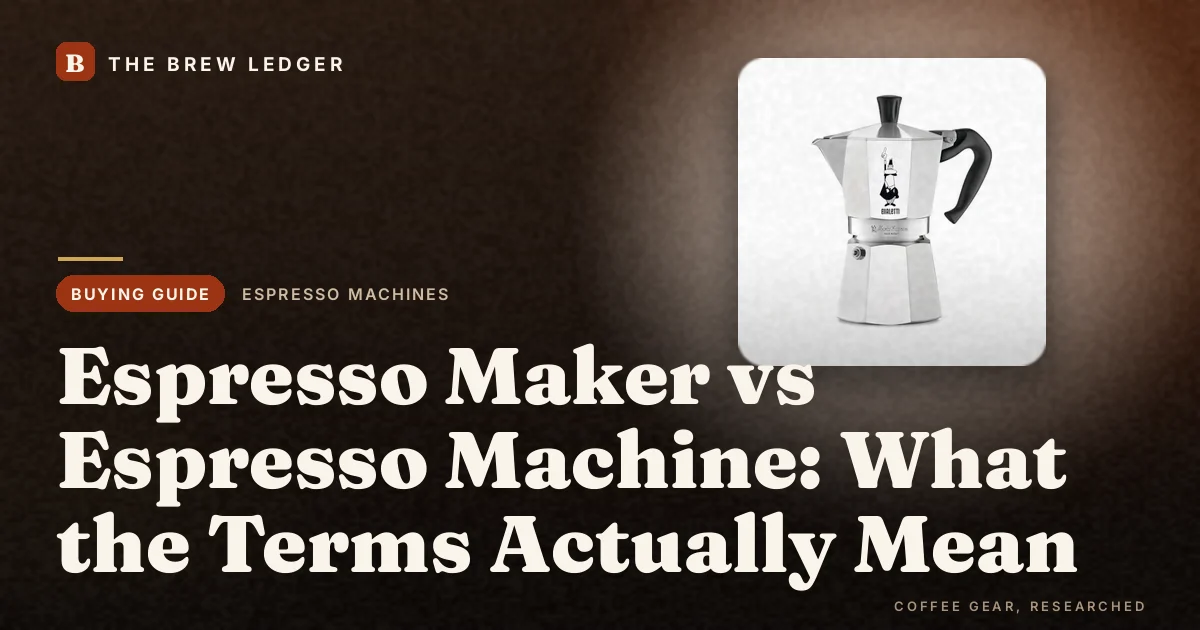
An espresso maker is usually a moka pot: stovetop brewing at about 1.5 bars that makes strong, espresso-style coffee without crema. An espresso machine uses a pump at 15 bars to force water through finely ground coffee, producing true espresso with crema. If your drinks need real shots for lattes, you need the machine. If you just want strong black coffee, the maker is enough.
Top picks at a glance
The picks, ranked
| Product | Invented | Body | Sizes | Heat source | Care |
|---|---|---|---|---|---|
| Bialetti Moka Express | 1933 by Alfonso Bialetti | Cast aluminum, octagonal | 1, 2, 3, 4, 6, 9, and 12 cups | Gas and electric stovetops (not induction) | Hand wash recommended |
| Breville Barista Express BES870XL | - | - | - | - | - |
| DeLonghi Stilosa EC260BK | - | - | - | - | - |
| DeLonghi Magnifica Evo ECAM29043SB | - | - | - | - | - |
Swipe sideways to compare all picks
01The classic 'espresso maker'
Bialetti Moka Express
The 1933 octagonal icon that defined stovetop coffee.
- Invented: 1933 by Alfonso Bialetti
- Body: Cast aluminum, octagonal
- Sizes: 1, 2, 3, 4, 6, 9, and 12 cups

When brands say 'espresso maker' they usually mean a moka pot like this: stovetop brewing at about 1.5 bars in sizes from 1-cup to 12-cup. Strong, heavy coffee, no electricity, no crema. It is espresso-style, not espresso.
Strengths
- In production since 1933 with the same octagonal aluminum design
- Seven sizes from 1 to 12 cups cover solo drinkers to dinner parties
- Steam pressure does the work; no plunging, pouring technique, or filters to buy
- Every gasket and filter plate is replaceable, so pots last decades
Limitations
- Aluminum body is not induction-compatible and should be hand washed
- Brew strength is fixed by the design; little room to experiment with recipes
- Leaving it on the heat too long scorches the coffee, the classic beginner mistake
| Invented | 1933 by Alfonso Bialetti |
|---|---|
| Body | Cast aluminum, octagonal |
| Sizes | 1, 2, 3, 4, 6, 9, and 12 cups |
| Heat source | Gas and electric stovetops (not induction) |
| Care | Hand wash recommended |
Sources: Bialetti official product specifications, Major retailer product listings, Published coffee gear reviews
What owners report
- Owners praise a design that has stayed in production since 1933, with the same octagonal aluminum shape
- Many owners like having seven sizes from 1 to 12 cups, covering solo drinkers through dinner parties
- Long-term owners say steam pressure does all the work, with no plunging, pouring technique, or filters to buy
- Some owners are frustrated that the aluminum body is not induction-compatible and needs hand washing
- Owners note brew strength is fixed by the design, leaving little room to experiment with recipes
- A common complaint is scorched coffee when the pot is left on the heat too long, a classic beginner mistake
Best for: Stovetop traditionalists who want strong, espresso-adjacent coffee with no technique beyond heat.
Skip if: You cook on induction; the aluminum body needs a gas or electric burner.
02The real espresso machine
Breville Barista Express BES870XL
The machine that defined home espresso: grinder, gauge, and steam wand in one box.
- Pump: 15-bar Italian pump
- Grinder: Integrated conical burr, 16 settings
- Water tank: 67 oz (2 L)

An espresso machine means a pump: 15 bars driving water through a 54 mm portafilter with low pressure pre-infusion. That is the 9-bar extraction zone that creates real crema and the body milk drinks are built on.
Strengths
- Integrated conical burr grinder with 16 settings removes the separate grinder purchase
- Low-pressure pre-infusion followed by 9-bar extraction for even, forgiving shots
- Analog pressure gauge shows the extraction zone while the shot pulls
- 67 oz water tank brews for days between refills
Limitations
- Thermocoil heat-up is slower than the ThermoJet models
- Manual steam wand takes practice to produce real microfoam
- 16 grind settings have coarser steps than the Pro and Touch with 30
| Pump | 15-bar Italian pump |
|---|---|
| Grinder | Integrated conical burr, 16 settings |
| Water tank | 67 oz (2 L) |
| Portafilter | 54 mm |
| Extraction | Low-pressure pre-infusion, 9-bar extraction |
Sources: Breville official product specifications, Major retailer product listings, Published coffee gear reviews
What owners report
- Owners praise the integrated conical burr grinder with 16 settings for removing a separate grinder purchase
- Many owners say low-pressure pre-infusion followed by 9-bar extraction makes shots even and forgiving
- Owners like the 67 oz tank, which keeps brewing going for days between refills
- Some owners find the thermocoil heat-up slower than the ThermoJet models
- Owners note the manual steam wand takes practice before it produces real microfoam
- A common complaint is that the 16 grind settings step more coarsely than the 30 on the Pro and Touch
Best for: Beginners who want an all-in-one machine and are willing to learn manual milk steaming.
Skip if: You want the fastest heat-up or push-button milk; the Pro and Touch do those better.
03Cheapest true machine
DeLonghi Stilosa EC260BK
The cheapest DeLonghi espresso: 15 bars, manual frother, pods or grounds.
- Pump: 15-bar
- Boiler: Stainless steel boiler
- Portafilter: 2-in-1: ESE pods or ground coffee

The Stilosa proves the price gap is real: its 15-bar pump and pressurized 51 mm baskets make actual espresso for a fraction of the Barista Express, minus the grinder and the refinement.
Strengths
- Lowest entry price in the DeLonghi range
- 15-bar pump with stainless steel boiler
- 2-in-1 portafilter takes ESE pods or ground coffee
- Two-level cup holder fits taller mugs
Limitations
- Manual milk frother is basic and underpowered
- Lightweight build with mostly plastic construction
- No grinder and no temperature control
| Pump | 15-bar |
|---|---|
| Boiler | Stainless steel boiler |
| Portafilter | 2-in-1: ESE pods or ground coffee |
| Milk | Manual frother |
| Cup clearance | Two-level cup holder |
Sources: DeLonghi official product specifications, Major retailer product listings, Published coffee gear reviews
What owners report
- Owners praise it as the lowest-priced way into the DeLonghi range
- Many owners like the 2-in-1 portafilter, which accepts ESE pods or ground coffee
- Owners say the two-level cup holder fits taller mugs that single-height trays cannot
- Some owners find the manual frother basic and short on steam power
- A common complaint is the lightweight, mostly plastic build
- Owners note there is no built-in grinder and no temperature control to grow into
Best for: Absolute beginners testing whether home espresso is for them.
Skip if: You already know you love espresso; the Dedica Arte is the smarter buy.
04The automated machine
DeLonghi Magnifica Evo ECAM29043SB
The modern Magnifica: color touch display and iced coffee, still with a manual frother.
- Recipes: 5 one-touch recipes
- Grinder: Conical burr, 13 settings
- Pump: 15-bar

The Magnifica Evo is what most buyers picture as an espresso machine: 13-setting grinder, 15-bar pump, and six one-touch drinks. Same pump physics as the Barista Express, with the barista removed.
Strengths
- Color icon touch display simplifies the one-touch menu
- 5 one-touch recipes: espresso, coffee, americano, iced coffee, long
- 13-setting conical burr grinder with 8.8 oz bean hopper
- 60 oz tank with removable, dishwasher-safe parts
Limitations
- Manual milk frother, like the Magnifica S
- 5 recipes is a short menu next to the Dinamica and Rivelia
- No user profiles for multi-drinker households
| Recipes | 5 one-touch recipes |
|---|---|
| Grinder | Conical burr, 13 settings |
| Pump | 15-bar |
| Water tank | 60 oz |
| Display | Color icon touch display |
Sources: DeLonghi official product specifications, Major retailer product listings, Published coffee gear reviews
What owners report
- Owners praise the color icon touch display for making the one-touch menu easy to navigate
- Many owners like having iced coffee among the one-touch recipes for warmer days
- Owners say the removable, dishwasher-safe parts take the sting out of cleanup
- Some owners wish the milk side were automatic, since the frother is still worked by hand
- A common complaint is the recipe list feeling short once you compare it with the Dinamica or Rivelia
- Owners in multi-drinker homes note the lack of user profiles for saved preferences
Best for: Buyers who want a current interface and iced coffee without paying for automatic milk.
Skip if: One-touch cappuccinos are the goal; this still steams milk by hand.
Questions, answered
Why is a moka pot called an espresso maker?
Marketing and history. Moka pots predate home pump machines and were sold as a way to make espresso-like coffee at home. The term stuck even though the 1.5-bar brewing pressure cannot produce true espresso.
Can an espresso maker make lattes?
Not proper ones. Lattes need espresso plus steamed milk, and moka pots have no steam wand and no crema. You can make a milky moka drink, but it will not taste or layer like a cafe latte.
How much pressure does real espresso need?
Around 9 bars at the coffee bed. Home pump machines like the Barista Express and Stilosa use 15-bar pumps that regulate down to that range. A moka pot's 1.5 bars is a different category entirely.
Which should I buy first?
Buy the moka pot if you drink strong black coffee and want to spend little. Buy a pump machine like the Stilosa if you want milk drinks or real espresso shots. Read moka pot vs espresso machine for the head-to-head numbers.