The pressure gap: 1.5 bars vs 9 bars, and exactly what that means in the cup.
Moka Coffee vs Espresso: Stovetop Strength Compared Honestly
Moka coffee vs espresso compared on pressure, crema, flavor, and cost: what 1.5 bars gives you and what only 9 bars can do.
The short answer
Moka coffee brews at about 1.5 bars: strong, heavy, and intense, but with no crema and less complexity. Espresso extracts at around 9 bars: syrupy body, real crema, and the concentration that milk drinks require. Moka wins on cost and simplicity. Espresso wins on texture and milk-drink capability. They are different drinks, not better and worse versions of one drink.
Top picks at a glance
The picks, ranked
| Product | Invented | Body | Sizes | Heat source | Care |
|---|---|---|---|---|---|
| Bialetti Moka Express | 1933 by Alfonso Bialetti | Cast aluminum, octagonal | 1, 2, 3, 4, 6, 9, and 12 cups | Gas and electric stovetops (not induction) | Hand wash recommended |
| Breville Barista Express BES870XL | - | - | - | - | - |
| DeLonghi Stilosa EC260BK | - | - | - | - | - |
| AeroPress Original | - | - | - | - | - |
Swipe sideways to compare all picks
01Best moka coffee
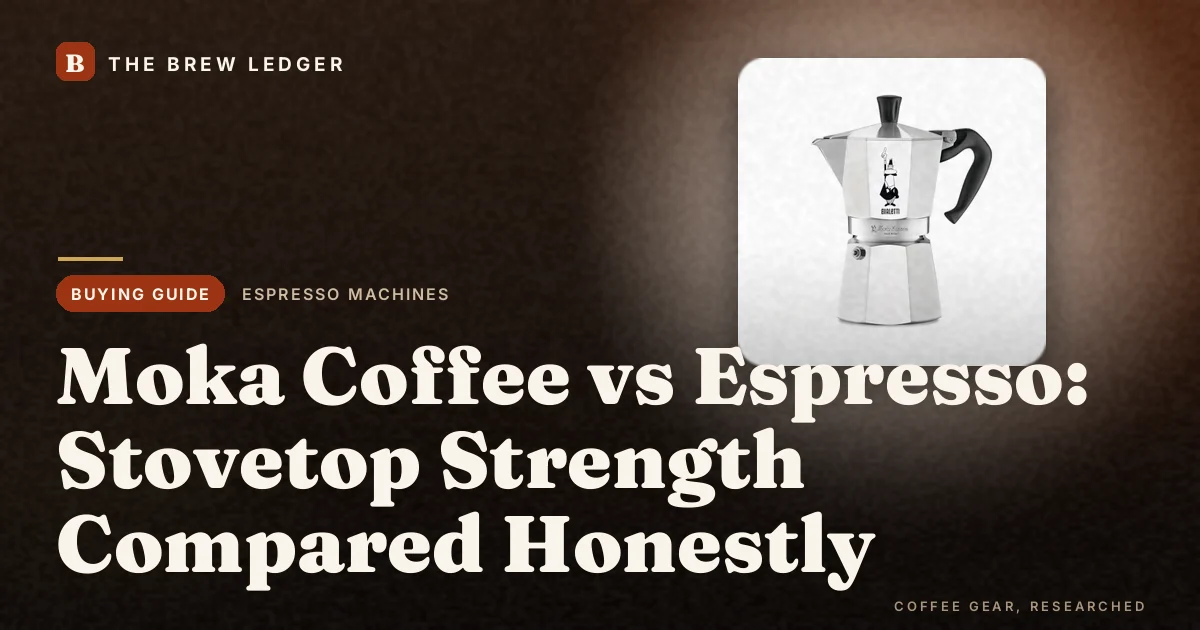
Bialetti Moka Express
The 1933 octagonal icon that defined stovetop coffee.
- Invented: 1933 by Alfonso Bialetti
- Body: Cast aluminum, octagonal
- Sizes: 1, 2, 3, 4, 6, 9, and 12 cups

The reference moka pot: 1.5 bars of stovetop pressure in sizes from 1-cup to 12-cup, producing heavy, intense coffee that stands up to milk. No pump, no electricity, no pretense about crema.
Strengths
- In production since 1933 with the same octagonal aluminum design
- Seven sizes from 1 to 12 cups cover solo drinkers to dinner parties
- Steam pressure does the work; no plunging, pouring technique, or filters to buy
- Every gasket and filter plate is replaceable, so pots last decades
Limitations
- Aluminum body is not induction-compatible and should be hand washed
- Brew strength is fixed by the design; little room to experiment with recipes
- Leaving it on the heat too long scorches the coffee, the classic beginner mistake
| Invented | 1933 by Alfonso Bialetti |
|---|---|
| Body | Cast aluminum, octagonal |
| Sizes | 1, 2, 3, 4, 6, 9, and 12 cups |
| Heat source | Gas and electric stovetops (not induction) |
| Care | Hand wash recommended |
Sources: Bialetti official product specifications, Major retailer product listings, Published coffee gear reviews
What owners report
- Owners praise a design that has stayed in production since 1933, with the same octagonal aluminum shape
- Many owners like having seven sizes from 1 to 12 cups, covering solo drinkers through dinner parties
- Long-term owners say steam pressure does all the work, with no plunging, pouring technique, or filters to buy
- Some owners are frustrated that the aluminum body is not induction-compatible and needs hand washing
- Owners note brew strength is fixed by the design, leaving little room to experiment with recipes
- A common complaint is scorched coffee when the pot is left on the heat too long, a classic beginner mistake
Best for: Stovetop traditionalists who want strong, espresso-adjacent coffee with no technique beyond heat.
Skip if: You cook on induction; the aluminum body needs a gas or electric burner.
02Best true espresso
Breville Barista Express BES870XL
The machine that defined home espresso: grinder, gauge, and steam wand in one box.
- Pump: 15-bar Italian pump
- Grinder: Integrated conical burr, 16 settings
- Water tank: 67 oz (2 L)

15 bars through a 54 mm portafilter with pre-infusion is the real extraction: syrupy body, genuine crema, and shots that hold up as the base of lattes and cappuccinos.
Strengths
- Integrated conical burr grinder with 16 settings removes the separate grinder purchase
- Low-pressure pre-infusion followed by 9-bar extraction for even, forgiving shots
- Analog pressure gauge shows the extraction zone while the shot pulls
- 67 oz water tank brews for days between refills
Limitations
- Thermocoil heat-up is slower than the ThermoJet models
- Manual steam wand takes practice to produce real microfoam
- 16 grind settings have coarser steps than the Pro and Touch with 30
| Pump | 15-bar Italian pump |
|---|---|
| Grinder | Integrated conical burr, 16 settings |
| Water tank | 67 oz (2 L) |
| Portafilter | 54 mm |
| Extraction | Low-pressure pre-infusion, 9-bar extraction |
Sources: Breville official product specifications, Major retailer product listings, Published coffee gear reviews
What owners report
- Owners praise the integrated conical burr grinder with 16 settings for removing a separate grinder purchase
- Many owners say low-pressure pre-infusion followed by 9-bar extraction makes shots even and forgiving
- Owners like the 67 oz tank, which keeps brewing going for days between refills
- Some owners find the thermocoil heat-up slower than the ThermoJet models
- Owners note the manual steam wand takes practice before it produces real microfoam
- A common complaint is that the 16 grind settings step more coarsely than the 30 on the Pro and Touch
Best for: Beginners who want an all-in-one machine and are willing to learn manual milk steaming.
Skip if: You want the fastest heat-up or push-button milk; the Pro and Touch do those better.
03Budget true espresso
DeLonghi Stilosa EC260BK
The cheapest DeLonghi espresso: 15 bars, manual frother, pods or grounds.
- Pump: 15-bar
- Boiler: Stainless steel boiler
- Portafilter: 2-in-1: ESE pods or ground coffee

The Stilosa's 15-bar pump crosses the pressure threshold that the moka pot cannot, for the lowest entry price in pump machines. The shots are real espresso, just less refined than the Barista Express.
Strengths
- Lowest entry price in the DeLonghi range
- 15-bar pump with stainless steel boiler
- 2-in-1 portafilter takes ESE pods or ground coffee
- Two-level cup holder fits taller mugs
Limitations
- Manual milk frother is basic and underpowered
- Lightweight build with mostly plastic construction
- No grinder and no temperature control
| Pump | 15-bar |
|---|---|
| Boiler | Stainless steel boiler |
| Portafilter | 2-in-1: ESE pods or ground coffee |
| Milk | Manual frother |
| Cup clearance | Two-level cup holder |
Sources: DeLonghi official product specifications, Major retailer product listings, Published coffee gear reviews
What owners report
- Owners praise it as the lowest-priced way into the DeLonghi range
- Many owners like the 2-in-1 portafilter, which accepts ESE pods or ground coffee
- Owners say the two-level cup holder fits taller mugs that single-height trays cannot
- Some owners find the manual frother basic and short on steam power
- A common complaint is the lightweight, mostly plastic build
- Owners note there is no built-in grinder and no temperature control to grow into
Best for: Absolute beginners testing whether home espresso is for them.
Skip if: You already know you love espresso; the Dedica Arte is the smarter buy.
04Middle-ground option
AeroPress Original
The 2005 original that turned a tube and a plunger into a brewing icon.
- Designer: Alan Adler (released 2005)
- Capacity: 1 to 3 cups per press
- Filters included: 350 paper micro-filters
The AeroPress sits between the two: gentle air pressure over immersion brewing makes a concentrated, clean cup in about two minutes. Stronger than moka in clarity, weaker than espresso in body. A good compromise for travelers.
Strengths
- Brews a full-immersion cup in about two minutes, then plunges through a paper micro-filter
- Ships with 350 paper micro-filters, plus a stirrer and scoop in the box
- Chamber and plunger rinse clean in seconds with no carafe to wash
- Compact and shatterproof, and a staple of brewing competitions worldwide
Limitations
- Makes 1 to 3 cups per press, so batch brewing means repeat presses
- Paper filters are a recurring consumable (a reusable steel filter fixes this)
- Grind size and plunge pressure take a few brews to dial in
| Designer | Alan Adler (released 2005) |
|---|---|
| Capacity | 1 to 3 cups per press |
| Filters included | 350 paper micro-filters |
| Brew method | Immersion plus gentle air pressure |
| Material | BPA-free polypropylene |
Sources: AeroPress official product specifications, Major retailer product listings, Published coffee gear reviews
What owners report
- Owners praise how a full-immersion cup is ready in about two minutes, with the paper micro-filter keeping it clean
- Many owners say the box is generous, with 350 paper micro-filters plus a stirrer and scoop included from day one
- Long-term owners like that the chamber and plunger rinse clean in seconds, with no carafe to scrub
- Some owners find the 1 to 3 cup limit frustrating, since brewing for a group means pressing again and again
- A common complaint is the ongoing cost of paper filters, since each press uses a fresh one unless you switch to steel
- Owners note that grind size and plunge pressure take a few brews to dial in before the cup tastes right
Best for: Brewers who want a fast, forgiving, travel-friendly cup with near-zero cleanup.
Skip if: You brew for more than three people at once; the chamber tops out at about three cups per press.
Questions, answered
Does moka coffee have crema?
No. Crema needs the emulsification that happens around 9 bars of pressure. Moka pots top out near 1.5 bars, so the dark foam some moka produces is just bubbles, not true crema. It fades in seconds.
Is moka coffee stronger than espresso?
Per sip it can taste bolder because it is often brewed concentrated, but a true espresso shot extracts more dissolved solids per ounce. Moka is strong coffee; espresso is a different, more intense extraction.
Can I make cappuccino with a moka pot?
You can make a milky coffee drink, but not a cappuccino. Without a steam wand you cannot create microfoam, and without crema the drink lacks the structure of the real thing. Our stovetop vs espresso machine comparison covers the milk gap in detail.
Which is cheaper to start with?
Moka, by an order of magnitude. A Moka Express costs a fraction of even the budget Stilosa pump machine, needs no grinder upgrade to taste good, and has no electricity cost. The pump machine earns its price in milk drinks and shot quality.