Head to head
Moka Pot vs Espresso Machine: Bialetti Moka Express vs Breville Barista Express
Head-to-head: Bialetti Moka Express versus Breville Barista Express on pressure, crema, milk drinks, workflow, and cost.
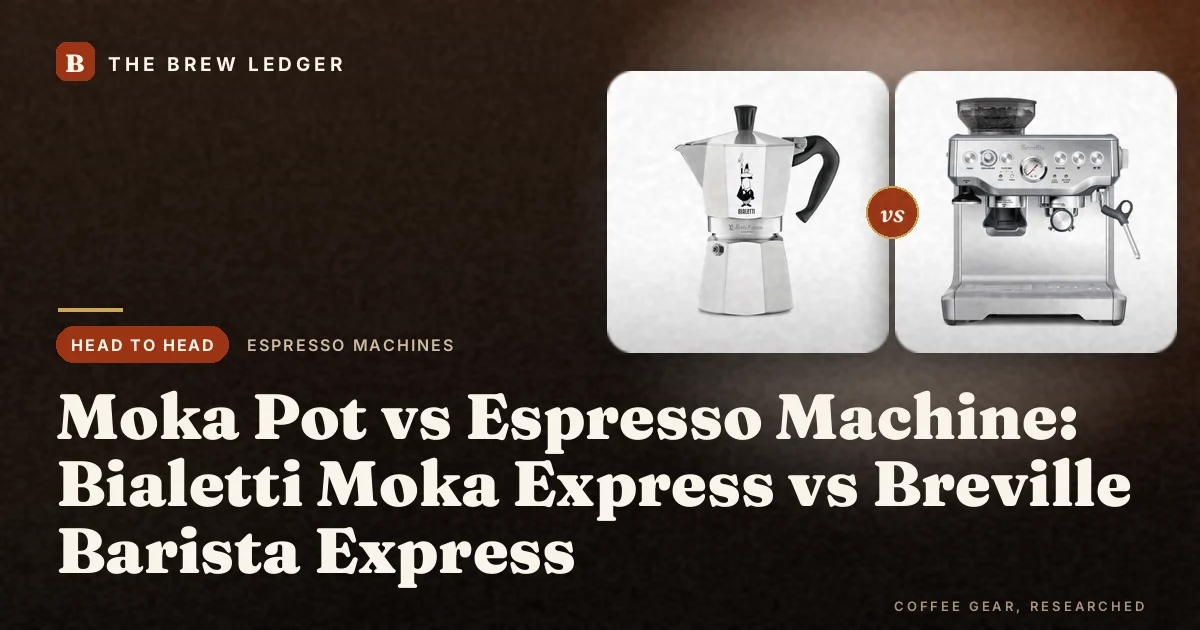

Bialetti Moka Express
The 1933 octagonal icon that defined stovetop coffee.
- Invented: 1933 by Alfonso Bialetti
- Body: Cast aluminum, octagonal
Sources: Bialetti official product specifications, Major retailer product listings, Published coffee gear reviews
Check current price
Breville Barista Express BES870XL
The machine that defined home espresso: grinder, gauge, and steam wand in one box.
- Pump: 15-bar Italian pump
- Grinder: Integrated conical burr, 16 settings
Sources: Breville official product specifications, Major retailer product listings, Published coffee gear reviews
Check current priceBialetti Moka Express
What owners report
- Owners praise a design that has stayed in production since 1933, with the same octagonal aluminum shape
- Many owners like having seven sizes from 1 to 12 cups, covering solo drinkers through dinner parties
- Long-term owners say steam pressure does all the work, with no plunging, pouring technique, or filters to buy
- Some owners are frustrated that the aluminum body is not induction-compatible and needs hand washing
- Owners note brew strength is fixed by the design, leaving little room to experiment with recipes
- A common complaint is scorched coffee when the pot is left on the heat too long, a classic beginner mistake
Breville Barista Express BES870XL
What owners report
- Owners praise the integrated conical burr grinder with 16 settings for removing a separate grinder purchase
- Many owners say low-pressure pre-infusion followed by 9-bar extraction makes shots even and forgiving
- Owners like the 67 oz tank, which keeps brewing going for days between refills
- Some owners find the thermocoil heat-up slower than the ThermoJet models
- Owners note the manual steam wand takes practice before it produces real microfoam
- A common complaint is that the 16 grind settings step more coarsely than the 30 on the Pro and Touch
Our recommendation
Buy the Moka Express if you drink strong black coffee and want maximum intensity per dollar with zero learning curve. Buy the Barista Express if you want true espresso, real crema, and milk drinks built on steamed milk. The 1.5-bar vs 15-bar gap is the whole decision: it separates strong coffee from actual espresso. Read the full Bialetti Moka Express review and Breville Barista Express review, or see both in our best brewers guide.
Pressure and extraction
The Moka Express brews at about 1.5 bars of steam pressure; the Barista Express pumps at 15 bars with low pressure pre-infusion. Only the pump reaches the 9-bar zone where true espresso extraction happens, emulsifying oils into crema and producing the syrupy body that defines the drink. Moka coffee is strong and heavy, but it is a different extraction with a lower ceiling on complexity.
Crema
The Barista Express produces genuine crema: the reddish-brown foam that signals proper emulsification and carries aroma. The Moka Express produces none; any foam on moka coffee is loose bubbles that vanish in seconds. If crema matters to you, the pump machine is the only option of the two.
Milk drinks
The Barista Express has a steam wand that textures milk into microfoam for lattes, cappuccinos, and flat whites. The Moka Express has no steam capability at all. You can pour hot milk into moka coffee for a strong milky drink, but it will not layer or taste like a cafe milk drink.
Workflow and skill
The Moka Express asks almost nothing: fill with water, add ground coffee, put it on the stove, and remove it at the gurgle. The Barista Express asks for a 16-setting grinder dialed in, manual dosing and tamping, and weeks of practice before shots stabilize. The moka pot is foolproof; the pump machine is a hobby that pays off.
Cost and footprint
The Moka Express costs a small fraction of the Barista Express, uses no electricity, and stores in a drawer. The Barista Express draws 1600W, weighs about 22 lb, and claims permanent counter space. Over years of use the moka pot's only recurring cost is coffee and a yearly gasket; the pump machine's is coffee, filters, and descaler.
Choose Bialetti Moka Express if…
- You drink strong black coffee and want the most intensity for the least money
- You have no counter space, no grinder, and no interest in learning technique
- You want a brewer with no electronics that lasts decades
Choose Breville Barista Express BES870XL if…
- You want true espresso with real crema
- Milk drinks like lattes and cappuccinos are part of your routine
- You are willing to spend a month learning grind, dose, and tamp
Questions, answered
Can a moka pot replace an espresso machine?
For strong black coffee, yes. For espresso-based drinks, no. The pressure gap means no crema, no true espresso extraction, and no steamed milk. It replaces the intensity, not the drinks.
Which is cheaper over five years?
The moka pot, by far. Its purchase price is a fraction of the Barista Express, it uses no electricity, and maintenance is a yearly gasket. The pump machine costs more up front and in upkeep, but produces drinks the moka pot cannot.
Does the Barista Express need a separate grinder?
No. The 16-setting conical burr grinder is built in, which is a core reason it wins this comparison for beginners. The moka pot needs pre-ground or separately ground coffee too, but is far less picky about grind quality.
Which makes better iced coffee?
The Barista Express: real espresso over ice with milk makes a proper iced latte. Moka coffee over ice is strong and pleasant but lacks the crema and body. Either beats most bottled options.