Buying guide
Super-Automatic Espresso Machine Buying Guide
How to choose a super-automatic espresso machine: grinder types, milk systems, drink menus, maintenance burden, and a decision framework for every buyer type.
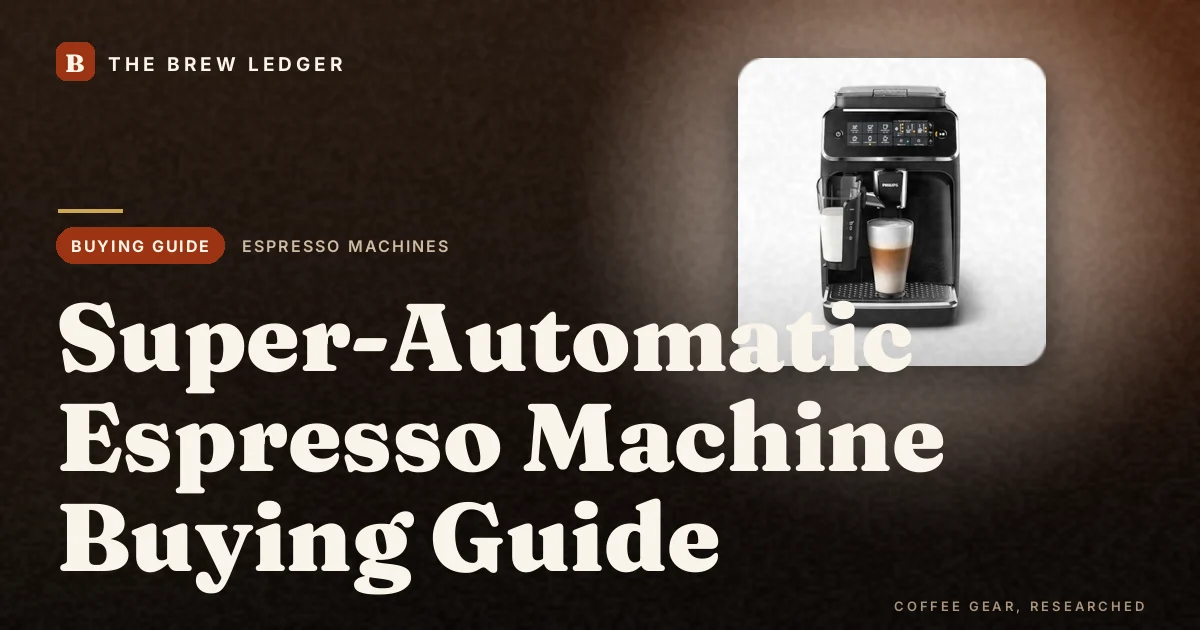
Start with our top 3


Grinder: ceramic vs steel, and why steps matter
The grinder is the heart of a super-auto since you cannot swap it. Ceramic burrs, in the Philips and Saeco machines, run cooler and stay sharp longer; steel conical burrs, in De'Longhi and Jura's AromaG3, have longer proven service histories. Step count, 12 on Philips, 13 on De'Longhi, 5 on the Gaggia Anima, decides how finely you can dial in different roasts. Bean explorers want more steps; set-and-forget drinkers do fine with fewer. Whatever you choose, feed it fresh medium roasts per our coffee beans guide, and never oily beans that gum the works.
Decision framework: match the machine to your drinks
Buy a one-touch milk machine if: your household drinks cappuccinos and lattes daily. The Philips 3200 LatteGo and Jura E8 make milk drinks at a button press with cleanup ranging from trivial to guided. Avoid one-touch milk if: you drink black coffee; you are paying for a milk system you will never use, and the Jura ENA 4 or De'Longhi Magnifica S serve you better for less. Buy a manual-frother model if: milk drinks are occasional and budget matters; the Magnifica S and Dinamica cover the rare cappuccino without the premium. Avoid manual frothers if: you make multiple milk drinks daily, the daily frothing and cleaning grind you down within months. Buy maximum menu depth if: four people order four different drinks; the Saeco Xelsis with 15 beverages and user profiles exists for exactly this household. Avoid deep menus if: everyone drinks the same thing; simplicity like the Gaggia Anima outlasts novelty.
Milk systems compared honestly
Three designs dominate. Tube-free carafes like LatteGo have 2 dishwasher-safe parts and no tubes: the easiest cleanup in the category. Integrated automatic frothers like Jura's fine foam produce the silkiest texture but need guided cleaning cycles. Manual frothers and panarello wands are cheapest and simplest mechanically but demand your time and technique every drink. Rank your tolerance for daily cleaning before ranking milk texture; the best-tasting system you will not clean becomes the worst system you own.
Maintenance: the real cost of ownership
Daily tasks are universal: empty drip tray and grounds, rinse the milk system. Weekly: rinse the removable brew group on Philips, De'Longhi, Gaggia, and Saeco models; Jura automates this with proprietary tablets since its group is sealed. Descaling intervals range from standard schedules to 5000 cups with Philips AquaClean filters. Jura adds recurring CLEARYL filter costs. When comparing prices, add two years of filters, tablets, and descaler; the cheapest machine is not always the cheapest ownership.
Size, tank, and hopper: the daily ergonomics
Footprints range from the ultra-compact Jura ENA 4 to the full-size Saeco Xelsis and Breville Oracle Touch with its 84 oz tank. Water tanks run 1.1 L on the ENA 4 to 1.9 L on the Jura E8; bean hoppers run 125 g to 300 g on the Dinamica. Small tanks and hoppers mean frequent refilling rituals that wear on busy households. Measure your counter, then buy the largest tank and hopper your space and budget allow.
When to choose the Breville Oracle Touch instead
The Oracle Touch is the category's honorable outsider: a dual boiler that grinds, doses, tamps, and steams automatically while leaving grind, dose, and milk texture under your control. Buy it if: you distrust full automation but want the labor done, or you make back-to-back milk drinks that need simultaneous brew and steam. Avoid it if: you want true one-touch operation; it still asks you to move the portafilter, and its footprint and price demand commitment. See Jura vs Breville for the full philosophical divide.
Questions, answered
How much should I spend on a super-automatic?
Budget tier, Magnifica S, covers black coffee reliably. Mid-tier, Philips 3200 or Magnifica Evo, adds one-touch milk and real menu depth: the sweet spot for most households. Premium, Jura E8 or Saeco Xelsis, buys the best cup quality, widest menus, and user profiles. Match the tier to your actual daily drinks, not aspirational ones.
Do I need a water filter?
Yes, either the manufacturer's filter or filtered water. Scale is the number one killer of super-autos, and filters like AquaClean and CLEARYL extend descaling intervals dramatically while improving taste. It is the cheapest longevity insurance you can buy.
Can super-automatics make decaf?
Yes via the bypass chute for pre-ground coffee, standard on most machines here. It is designed for the occasional decaf, not daily use; whole beans through the grinder remain the point of the machine.
How long do super-automatics last?
With maintenance, many years: Jura and De'Longhi have strong long-term records, and ceramic grinders extend service life. The machines that die young are the ones whose brew groups never got rinsed and whose descaling was postponed. Maintenance discipline matters more than brand.