For buyers choosing between the two materials
Stainless Steel vs Glass French Press: Which Is Better?
Stainless steel vs glass French press compared on heat retention, durability, filtration, and price.
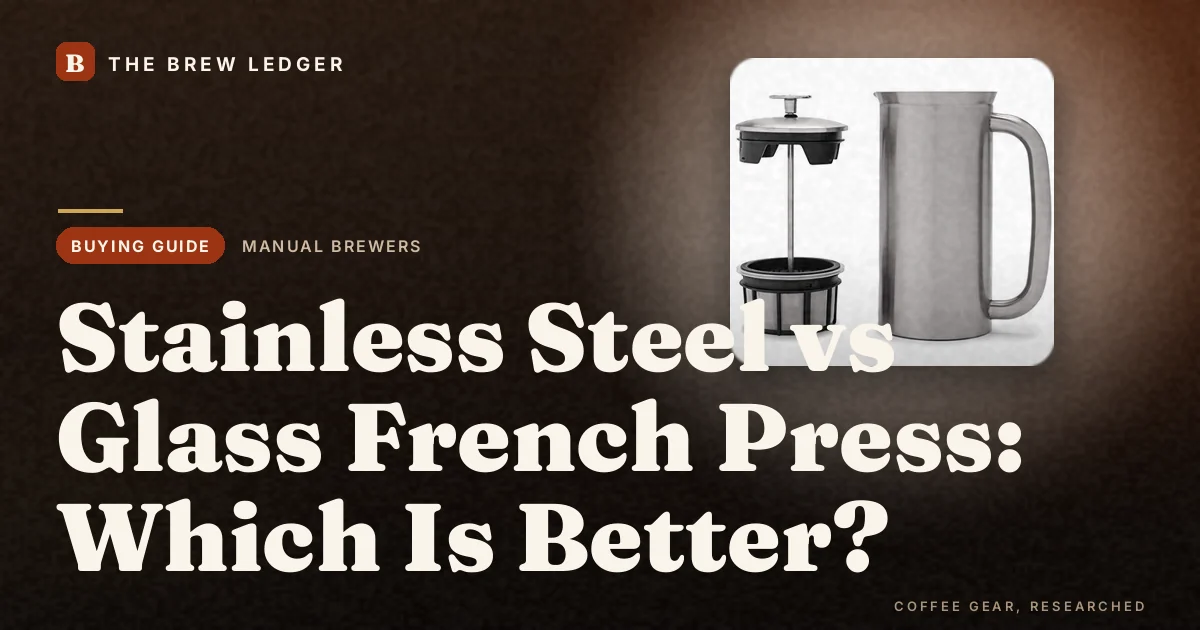
The short answer
Choose stainless steel if heat retention and durability matter: double-wall vacuum presses like the Espro P7 keep coffee hot for hours and survive drops. Choose glass if budget and visibility matter: the Bodum Chambord brews the same core cup for less and lets you watch the steep. Steel wins on performance, glass wins on price.
Top picks at a glance
The picks, ranked
| Product | Capacity | Filtration | Body | Effect | Heat retention |
|---|---|---|---|---|---|
| Espro P7 | 32 oz (1 liter) | Patented double micro-filter | Double-wall vacuum-insulated stainless steel | Stops extraction after plunging | Keeps coffee hot for hours |
| Frieling Double-Walled French Press | 36 oz | - | - | - | - |
| Bodum Chambord | - | - | - | - | - |
| Bodum Brazil | - | - | - | - | - |
Swipe sideways to compare all picks
01Best stainless steel overall
Espro P7
The double-filtered, vacuum-insulated press that brews the cleanest French press cup.
- Capacity: 32 oz (1 liter)
- Filtration: Patented double micro-filter
- Body: Double-wall vacuum-insulated stainless steel

The P7 pairs vacuum-insulated steel with the double micro-filter, so you get heat retention and the cleanest cup in one press. If you are going steel, this is the no-compromise version.
Strengths
- Patented double micro-filter (two fine baskets) strains out far more sediment
- Double-wall vacuum-insulated stainless steel keeps coffee hot for hours
- 32 oz (1 liter) capacity suits 2 to 4 mugs
- Filter design stops extraction, so the last cup is not overbrewed
Limitations
- Premium price, multiples of a basic glass press
- Heavier than glass presses at the same capacity
- You cannot watch the brew through steel walls
| Capacity | 32 oz (1 liter) |
|---|---|
| Filtration | Patented double micro-filter |
| Body | Double-wall vacuum-insulated stainless steel |
| Effect | Stops extraction after plunging |
| Heat retention | Keeps coffee hot for hours |
Sources: Espro official product specifications, Major retailer product listings, Published coffee gear reviews
What owners report
- Owners praise the twin micro-filter baskets for pouring a noticeably cleaner cup than a standard single screen
- Long-term owners say the vacuum-insulated steel body keeps a morning pot hot for hours instead of minutes
- Many owners like that the filter halts brewing after the plunge, so the last cup poured tastes like the first
- Some owners balk at paying several times the price of a basic glass press for the filtration upgrade
- Owners note the steel body adds real heft compared with glass presses of similar size
- A common complaint is losing the visual check on the steep because the walls are opaque steel
Best for: French press lovers who hate sludge and want coffee that stays hot.
Skip if: You are on a tight budget; the filtration upgrade costs several times a basic press.
02Best steel build
Frieling Double-Walled French Press
All-steel, double-walled press built to outlive glass rivals.
- Capacity: 36 oz
- Construction: 18/8 stainless steel, double-walled
- Finish: Mirror-polished exterior

Double-walled 18/8 steel with a mirror finish and a 36 oz capacity. The toughest press here, and every part is dishwasher safe. Buy it to never think about your press again.
Strengths
- 18/8 stainless steel double-wall construction keeps coffee hot far longer than glass
- 36 oz capacity serves about four mugs
- Every part is dishwasher safe and nearly indestructible
- Mirror-polished exterior wipes clean and looks sharp for years
Limitations
- Premium price for the all-steel build
- Heavier than glass presses
- No visibility into the brew
| Capacity | 36 oz |
|---|---|
| Construction | 18/8 stainless steel, double-walled |
| Finish | Mirror-polished exterior |
| Care | All parts dishwasher safe |
| Filter | Fine-mesh stainless filter assembly |
Sources: Frieling official product specifications, Major retailer product listings, Published coffee gear reviews
What owners report
- Owners praise the double-walled 18/8 steel construction for keeping coffee hot well beyond what glass manages
- Long-term owners say the whole press survives dishwasher cycles and daily knocks without showing its age
- Many owners like the mirror finish, which wipes clean and keeps looking polished on the counter
- Some owners find the all-steel build hard to justify at its premium price point
- Owners note it is noticeably heavier to lift and pour than a glass press
- A common complaint is being unable to judge how much coffee is left without lifting the lid
Best for: Buy-it-for-life brewers who want steel durability and serious heat retention.
Skip if: You want to see the coffee level; steel hides the brew.
03Best glass overall
Bodum Chambord
The chrome-and-glass French press design that has defined the category since the 1950s.
- Design: Iconic French press, dating to the 1950s
- Beaker: Borosilicate glass
- Filter: 3-part stainless steel

The Chambord's glass beaker shows the brew, costs less than any steel rival, and replacement beakers are cheap if one breaks. The classic choice when budget and visibility matter.
Strengths
- Borosilicate glass beaker resists thermal shock and will not affect flavor
- Three-part stainless steel filter assembly is simple and fully replaceable
- Four sizes from 12 to 51 oz cover solo brewing to entertaining
- The 34 oz (8-cup) size is the standard household French press
Limitations
- Glass beaker can break if knocked; Bodum sells replacements
- Metal filter lets fine sediment through, so the last sip is silty
- Glass loses heat fast; coffee cools quickly without a cozy
| Design | Iconic French press, dating to the 1950s |
|---|---|
| Beaker | Borosilicate glass |
| Filter | 3-part stainless steel |
| Sizes | 12, 17, 34, and 51 oz |
| Care | Glass beaker is dishwasher safe |
Sources: Bodum official product specifications, Major retailer product listings, Published coffee gear reviews
What owners report
- Owners praise the borosilicate glass beaker for resisting thermal shock without affecting flavor
- Many owners like the three-part stainless steel filter assembly being simple and fully replaceable
- Owners say the four sizes from 12 to 51 oz cover everything from solo brewing to entertaining
- Some owners worry the glass beaker can break if knocked, even though replacements are sold
- A common complaint is fine sediment from the metal filter leaving the last sip silty
- Owners note the glass loses heat fast, so coffee cools quickly without a cozy
Best for: French press traditionalists who want the iconic look and a rich, full-bodied cup.
Skip if: You hate sediment; even the best press leaves fine silt in the cup.
04Best budget glass
Bodum Brazil
Bodum's budget press: the same glass beaker and steel filter with a plastic frame.
- Beaker: Borosilicate glass
- Frame: BPA-free plastic
- Filter: 3-part stainless steel

Same glass-and-steel brewing core as the Chambord in a plastic frame. The cheapest credible press in this guide, and proof that glass does not have to cost much.
Strengths
- Borosilicate glass beaker identical in function to the Chambord's
- Three-part stainless steel filter assembly
- BPA-free plastic frame keeps the price down and stays cool to touch
- Available in 12, 34, and 51 oz sizes
Limitations
- Plastic frame looks and feels cheaper than the Chambord's chrome
- Same sediment and heat-loss trade-offs as any glass press
- Plastic can stain or retain odors over years of heavy use
| Beaker | Borosilicate glass |
|---|---|
| Frame | BPA-free plastic |
| Filter | 3-part stainless steel |
| Sizes | 12, 34, and 51 oz |
| Position | Bodum's entry-level French press |
Sources: Bodum official product specifications, Major retailer product listings, Published coffee gear reviews
What owners report
- Owners praise getting the same brewing core as Bodum's pricier chrome press at an entry-level price
- Many owners like that the plastic frame stays comfortable to grip even with a full pot of hot coffee
- Owners say the choice of 12, 34, and 51 oz sizes covers everything from one mug to a family breakfast
- Some owners feel the plastic frame looks cheap sitting next to stainless appliances
- Owners note the familiar glass-press trade-offs remain, with sediment in the cup and heat fading fast
- A common complaint is the frame picking up stains and lingering odors after years of daily use
Best for: First-time French press buyers who want the real Bodum brew for the lowest price.
Skip if: You want the heirloom look; the plastic frame is functional, not beautiful.
Questions, answered
Does a steel French press brew better coffee?
Not inherently; the brew method is identical. Steel's advantages are heat retention (your second cup stays hot) and durability. Filtration quality depends on the filter design, not the beaker material: Espro's double micro-filter beats basic steel screens.
How much longer does steel keep coffee hot?
Substantially. A glass beaker loses drinkable heat in 20 to 30 minutes; a double-wall vacuum press like the Espro P7 holds heat for hours, and the Stanley Classic is rated up to 4 hours. If you sip slowly, steel changes the experience.
Can you put a glass French press on the stove?
No. Borosilicate glass handles hot water fine but not direct burner heat. Preheat the beaker with hot water instead, which also reduces heat loss during the steep.
Is stainless steel safer than glass?
Both are safe for brewing. Steel's safety advantage is practical: no shattering. Glass's advantage is visibility and lower cost. Either way, look for food-grade materials (borosilicate glass, 304/18-8 steel).