Head to head
Percolator vs French Press
Percolator vs French press compared on brew method, strength, body, batch size, and ease, with the Farberware and Stanley as reference percolator picks.
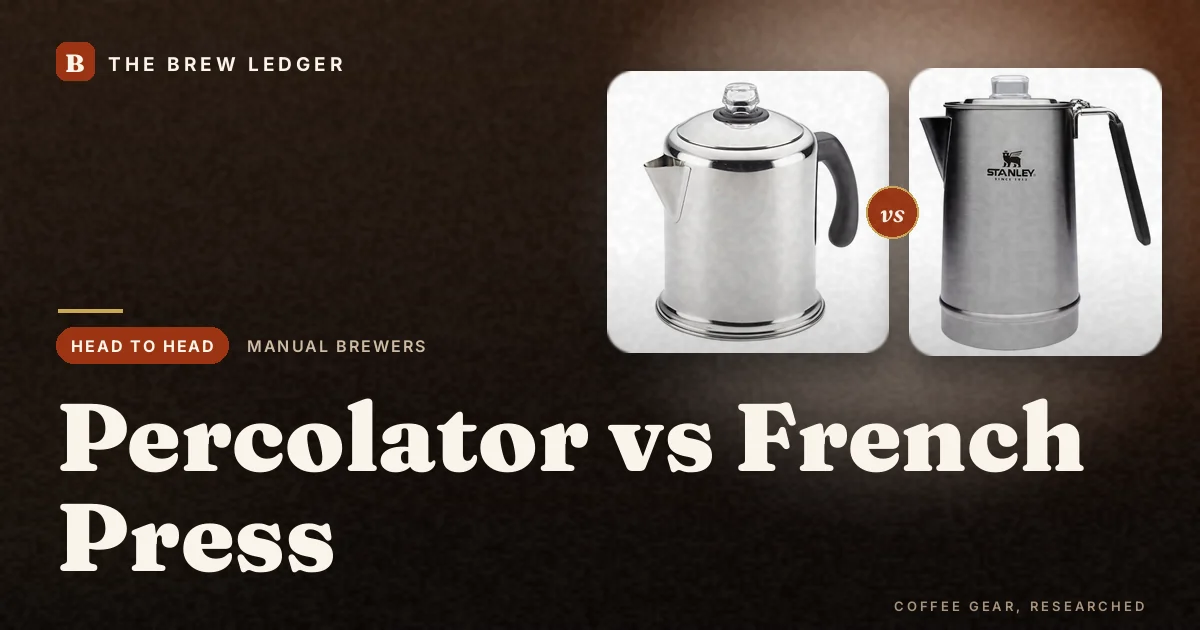

Farberware Classic Yosemite Percolator
The stainless steel electric percolator that has anchored American kitchens for generations.
- Type: Electric percolator
- Sizes: 8-cup and 12-cup
Sources: Farberware official product specifications, Major retailer product listings, Published coffee gear reviews
Check current price
Stanley Camp Percolator
A rugged 6-cup stainless steel stovetop percolator from the camp-kitchen legend.
- Type: Stovetop percolator
- Capacity: 6 cup
Sources: Stanley official product specifications, Major retailer product listings, Published coffee gear reviews
Check current priceFarberware Classic Yosemite Percolator
What owners report
- Owners praise the stainless steel body in 8-cup and 12-cup sizes for brewing for a crowd
- Many owners value automatic keep-warm holding coffee at serving temperature after brewing
- Owners appreciate the ready light signaling when the brew cycle is complete, and the detachable cord for table serving
- Some owners find the bulky footprint takes real counter space
- A common complaint is the lack of brew-strength control, leaving perk timing entirely up to the user
- Owners note the interior stem and basket assembly has several parts to wash
Stanley Camp Percolator
What owners report
- Owners praise the 18/8 stainless steel body for shrugging off camp abuse
- Many owners say the 6-cup size is ideal for two to three campers
- Owners appreciate the cool-grip handle and the removable stopper and filter assembly that clean up easily
- Some owners find the 6-cup maximum will not serve a group
- A common complaint is that it is heavier than aluminum camp percolators
- Owners note there is no whistle or indicator, so timing the perk is entirely manual
Our recommendation
Choose a percolator like the Farberware Classic if you want the boldest traditional cup and brew large batches with keep-warm automation. Choose a French press if you want a full-bodied but mellower cup with the simplest possible technique. Campers deciding on stovetop gear should note the Stanley Camp Percolator brews where no press can go: over a camp stove. Our best percolators ranking covers the full percolator field.
Brew method
Percolators cycle near-boiling water up through the grounds repeatedly for 7 to 10 minutes. French presses steep coarse grounds in hot water for four minutes, then filter with a mesh plunger. Cycling versus steeping is the core mechanical difference, and it drives everything about the cup.
Strength and flavor
Percolated coffee is bolder and more intense, with a robust, old-school character. French press coffee is full-bodied but mellower and sweeter, with more aromatic nuance. Percolators risk bitterness when over-perked; presses risk sourness when under-steeped. Both punish inattention, in opposite directions.
Body and sediment
French press coffee has the heavier body: the mesh screen lets oils and fine sediment through. Percolated coffee is cleaner, the basket holds back most sediment, but still rich from the repeated extraction. Choose weight versus clarity based on which texture you enjoy.
Batch size and automation
Electric percolators like the Farberware brew 12 cups with automatic keep-warm, ideal for households and entertaining. French presses top out around 8 cups (34 oz) for common sizes and have no heating element. For big batches that stay hot, the electric percolator wins; for simple small batches, the press is easier.
Skill and cleanup
French press technique is nearly foolproof: coarse grind, hot water, four minutes, plunge. Percolators demand heat management and timing, too long a perk turns bitter. Cleanup favors the press slightly: one beaker and screen versus the percolator's stem, basket, and spreader assembly.
Choose Farberware Classic Yosemite Percolator if…
- You want the boldest traditional coffee and brew 8 to 12 cups at a time.
- Automatic keep-warm for serving a household or guests matters to you.
- You enjoy the ritual of timing the perk and dialing in the technique.
Choose Stanley Camp Percolator if…
- You brew outdoors on stoves and campfires where electric presses cannot go: the Stanley is built for it.
- You want a rugged small-batch stovetop percolator in bombproof 18/8 stainless steel.
- Six cups covers your crew and you prefer steel over enamelware for rough handling.
Questions, answered
Which makes stronger coffee?
The percolator, clearly. Repeated cycling of near-boiling water extracts more intensity than a four-minute steep. If bold is the goal, percolate.
Which is better for beginners?
The French press. The technique has almost no failure modes, while percolators require timing and heat control to avoid bitterness. Beginners should start with the press or an electric percolator with a ready light.
Can I take either camping?
Only the percolator, in stovetop form: the Stanley and Coleman brew on camp stoves and fires. A French press needs pre-heated water from another vessel, which works but adds a step and a kettle.
Which is easier to clean?
The French press: rinse the beaker and screen. Percolators add a stem, basket, and spreader to the washing up. Our buying guide covers what to expect from each format.