Fix it
Percolator Troubleshooting
Fix every common percolator problem: grounds in the cup, weak coffee, bitter over-perked brews, no percolation, and leaks, with causes and solutions.
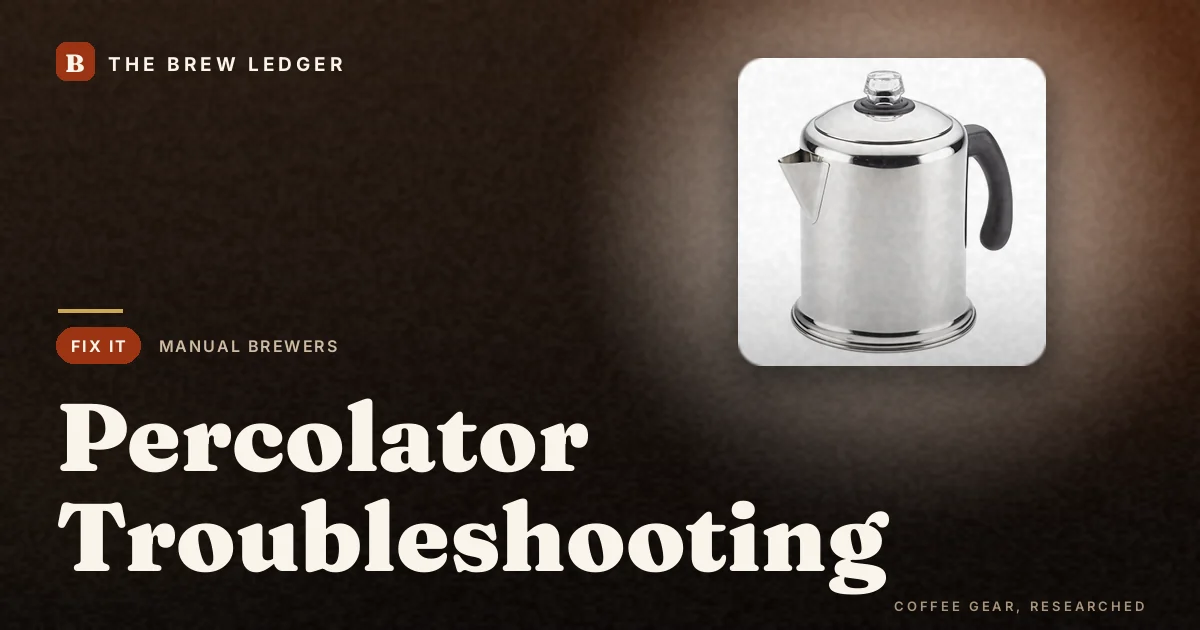
Percolator problems come from a short list: grind size, perk time, heat level, and assembly. Fix them in that order and nearly every bad batch is recoverable. The golden rule: coarse grind, gentle perk, 7 to 10 minutes, off the heat promptly.
Grounds in the cup
The grind is too fine for the basket perforations. Move to a true coarse grind, like rough sea salt, and the particles will stay put. Also check that the basket lid and spreader are seated correctly; a misaligned spreader lets water jet grounds over the basket edge. A little fine sediment is normal, but visible grounds mean coarsen the grind.
Coffee is weak and watery
Weak percolator coffee means under-extraction: too little coffee, too short a perk, or too coarse a grind combined with too little time. Use 1 tablespoon per cup of water, perk a full 7 to 10 minutes, and make sure the batch size matches the percolator: a half-full pot brews unevenly and tastes thin.
Coffee tastes bitter and harsh
Bitterness is over-extraction: perked too long, boiled too vigorously, or ground too fine. Cap the perk at 10 minutes maximum, reduce heat to a gentle lazy bubble, and use a coarse grind. On electric models, serve promptly rather than letting the batch sit on keep-warm for an hour.
Percolator never starts perking
On stovetop models, the heat is too low or the stem tube is clogged with old grounds; clear the tube and raise the heat until you hear the cycle start. On electric models, check that the unit is plugged in firmly, the thermostat has not tripped, and the heating well is free of heavy scale, which insulates the element.
Coffee sputters and boils over
The heat is far too high. Percolation should be a gentle bubble every couple of seconds, not a rolling boil. Lower the burner or move the pot partially off the heat. Overfilling past the maximum fill line also causes boil-over, so respect the marked capacity.
Coffee tastes stale or off despite fresh beans
Old coffee oils build up in the stem, basket, and spreader, turning rancid between brews. Disassemble all parts and wash in hot soapy water after every use, and run a periodic vinegar-water cycle through electric models to descale. If the pot sat unused, a full disassembly wash before the next brew fixes most off flavors.
Questions, answered
Why does my percolator coffee taste burnt?
Burnt flavor comes from boiling too vigorously or perking too long, often both. Keep the perk gentle and capped at 10 minutes, and on stovetop models pull the pot the moment the cycle looks dark enough. Electric keep-warm left for over an hour also scorches the batch.
How do I clean a percolator properly?
Disassemble the stem, basket, spreader, and lid after every brew and wash in hot soapy water. Wipe the body, descale electric models periodically with a vinegar-water cycle, and dry everything before reassembly to prevent musty flavors.
Can I re-perk leftover coffee?
No. Re-perking already-brewed coffee over-extracts it into undrinkable bitterness. Brew only what you will drink, and use the keep-warm function for holding, not re-brewing.
Why is one batch fine and the next bitter?
Inconsistent heat or timing. Stovetop burners vary, so watch for the gentle perk rather than timing blindly. On electrics, the usual cause is different batch sizes: a smaller batch in a big pot over-extracts. Keep batch size consistent.