Head to head
Moka Pot vs Espresso Machine
Moka pot vs espresso machine: pressure, crema, cost, and counter space compared honestly, with the Brikka and Moka Express as the stovetop representatives.
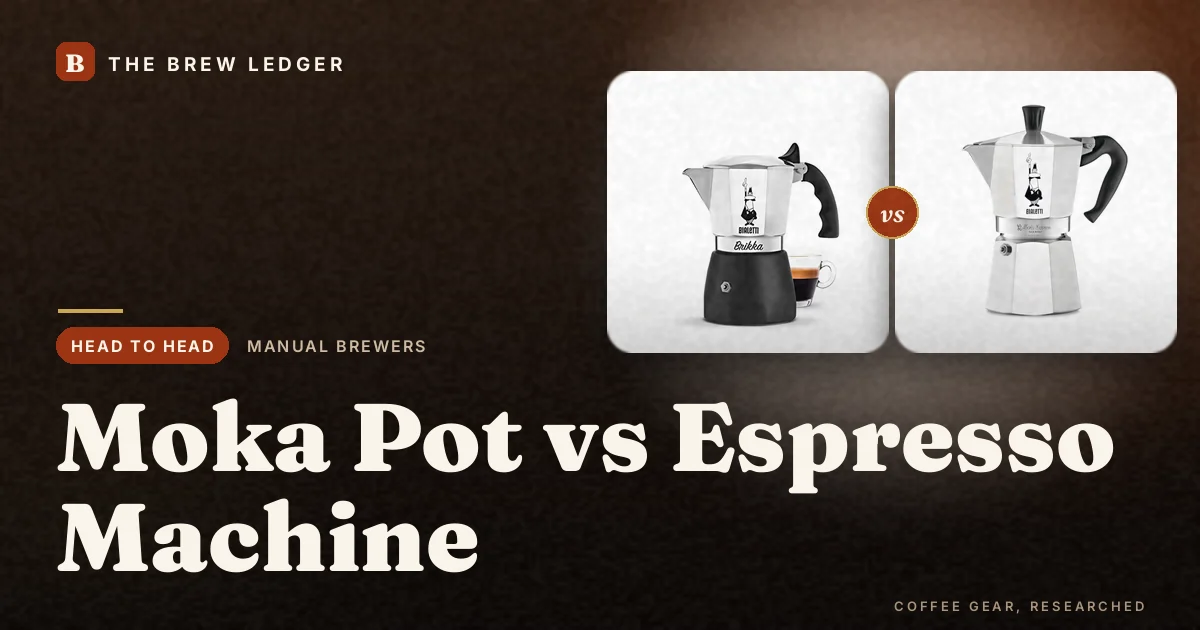

Bialetti Brikka
The only moka pot with a pressure valve that builds crema, the closest stovetop brewing gets to espresso.
- Material: Aluminum with silicone pressure valve
- Sizes: 2 and 4 cup
Sources: Bialetti official product specifications, Major retailer product listings, Published coffee gear reviews
Check current price
Bialetti Moka Express
The 1933 octagonal icon that defined stovetop coffee.
- Invented: 1933 by Alfonso Bialetti
- Body: Cast aluminum, octagonal
Sources: Bialetti official product specifications, Major retailer product listings, Published coffee gear reviews
Check current priceBialetti Brikka
What owners report
- Owners praise the weighted pressure valve for holding the brew back until pressure builds, leaving a real crema layer on top
- Many owners say it delivers the richest, most espresso-like cup they have had from a stovetop pot
- Owners like the simple three-chamber cleaning, which works just like the classic Moka Express
- Some owners are frustrated that the aluminum body rules out induction cooktops
- A common complaint is the narrow choice of just 2-cup and 4-cup sizes
- Owners note the valve needs periodic descaling to keep the crema performance consistent
Bialetti Moka Express
What owners report
- Owners praise a design that has stayed in production since 1933, with the same octagonal aluminum shape
- Many owners like having seven sizes from 1 to 12 cups, covering solo drinkers through dinner parties
- Long-term owners say steam pressure does all the work, with no plunging, pouring technique, or filters to buy
- Some owners are frustrated that the aluminum body is not induction-compatible and needs hand washing
- Owners note brew strength is fixed by the design, leaving little room to experiment with recipes
- A common complaint is scorched coffee when the pot is left on the heat too long, a classic beginner mistake
Our recommendation
Buy a moka pot if you want strong, dense coffee for a fraction of an espresso machine's cost and counter space: the Bialetti Brikka gets closest to espresso with its crema valve, while the Moka Express is the versatile classic. Buy a true espresso machine only if you need 9-bar extraction, real crema, and milk-steaming capability, and you accept the cost, maintenance, and learning curve. For most strong-coffee drinkers, the Brikka covers the craving. Our best moka pots ranking has the full stovetop lineup.
Brewing pressure
Pump espresso machines brew at 9 bars of pressure; moka pots work at roughly 1.5 bars. That pressure gap is the fundamental difference: 9 bars emulsifies oils into thick, persistent crema and extracts more intensity, while 1.5 bars produces strong coffee with body but no true crema. The Brikka's valve narrows the gap but does not close it.
Crema
Real crema, the hazelnut-colored emulsion on espresso, requires pump pressure. Standard moka pots produce none; the Bialetti Brikka's weighted valve produces a crema-like layer that looks the part but dissipates faster. If crema is the goal rather than a nice-to-have, only a pump machine delivers it.
Cost and counter space
A moka pot costs a fraction of even an entry-level pump machine and stores in a cabinet. Espresso machines demand counter space, plus a grinder capable of true espresso-fine grinding, which is itself a significant purchase. The total cost of an espresso setup is an order of magnitude above a moka pot.
Skill and maintenance
Moka pots are forgiving: medium-fine grind, fill loosely, medium heat. Espresso machines require dialing in grind, dose, and tamp, plus backflushing, descaling, and gasket maintenance. The moka pot's simplicity is a feature for anyone who wants strong coffee without a hobby.
Milk drinks
Espresso machines with steam wands make lattes and cappuccinos; moka pots cannot steam milk. Moka coffee works well in milk as a strong base, heated milk poured over moka brew approximates a latte in flavor if not in texture, but microfoam is out of reach.
Choose Bialetti Brikka if…
- You want the closest thing to espresso from a stovetop pot: the Brikka's crema valve is the key feature.
- You brew for one or two people and the 2 and 4 cup sizes fit your routine.
- You want strong coffee without the cost, counter space, or maintenance of a pump machine.
Choose Bialetti Moka Express if…
- You want the classic moka ritual in the widest size range, from 1-cup solo to 12-cup entertaining.
- You brew on gas or coil and want the fastest heat-up at the lowest proven price.
- Crema is a nice-to-have, not the goal; dense, chocolatey coffee is enough.
Questions, answered
Can a moka pot replace an espresso machine?
For strong black coffee, largely yes: moka brew is dense and intense. For true espresso with persistent crema and milk-steaming, no. The Brikka closes about two-thirds of the gap. Be honest about whether you drink straight shots or milk drinks before deciding.
Which is cheaper overall?
The moka pot, by an order of magnitude. A Bialetti costs a fraction of an entry-level pump machine, and you avoid the espresso-capable grinder purchase that a machine setup also requires.
Does moka pot coffee have more caffeine?
Per ounce, espresso is more concentrated, but a 6-cup moka pot brews about 10 oz versus a 2 oz double shot, so the total caffeine in a full moka serving is higher. Compare serving sizes, not just concentration.
Is the Brikka as good as a cheap espresso machine?
For black coffee, many drinkers prefer the Brikka's cup to a bargain pump machine's inconsistent shots. Cheap machines often have pressurized baskets and temperature instability. The Brikka is simpler and more repeatable, though it cannot steam milk.