Buying guide
Espresso Machine Buying Guide
How to choose a home espresso machine: boiler types, grinder decisions, portafilter standards, steam needs, and a decision framework for single vs dual boiler vs heat exchanger.
Start with our top 3


The grinder decision comes first
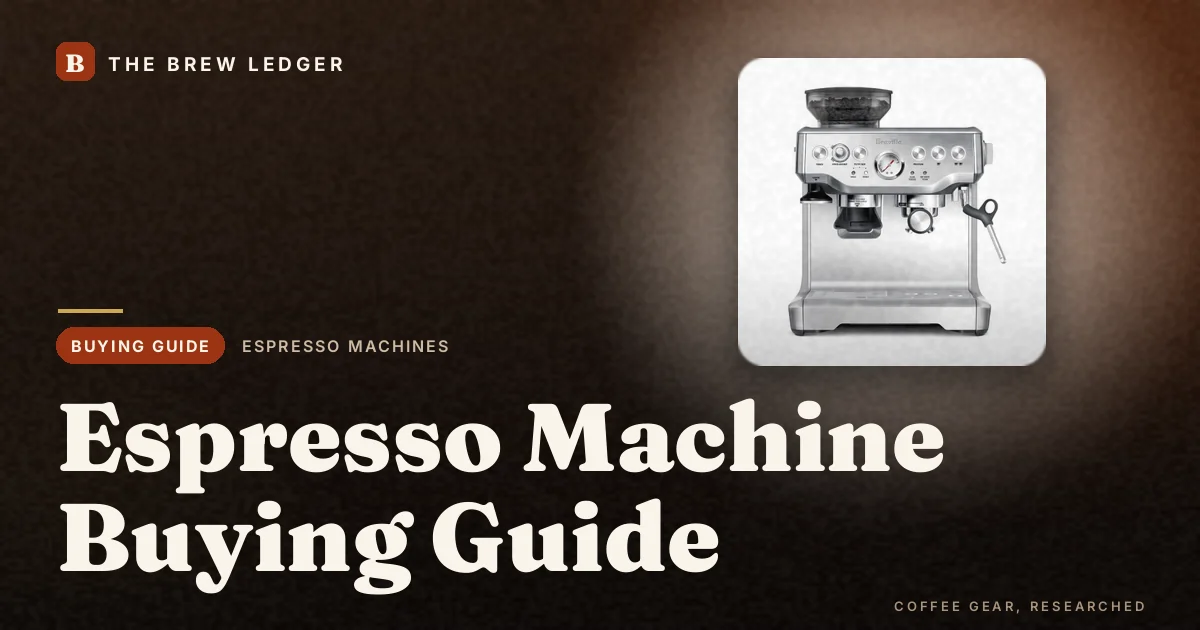
An espresso machine is only as good as the grinder feeding it. Non-pressurized baskets punish inconsistent grinds with channeling and sour shots, which is why all-in-one machines like the Barista Express exist: the built-in conical burr grinder removes the hardest separate purchase. If you buy a grinder-less machine like the Gaggia Classic Pro or Bambino Plus, budget a capable burr grinder as part of the purchase, not an accessory. A weak grinder wastes a good machine completely.
Decision framework: single boiler vs heat exchanger vs dual boiler
Buy a single boiler or thermocoil machine if: you make one or two drinks at a time, mostly straight espresso or Americanos, or you are learning and want the simplest machine. Every pick in our best espresso machines roundup is single-boiler or thermocoil, including the Barista Express and Gaggia Classic Pro. Avoid single boiler if: your household makes four or more milk drinks every morning; the brew-then-steam sequencing becomes a real chore. Buy a heat exchanger if: you want to brew and steam simultaneously without dual-boiler cost, and you accept cooling flushes before shots. Buy a dual boiler if: you make back-to-back milk drinks daily and want independent PID temperature control for brewing and steaming; it is the endgame for milk-heavy households, at endgame prices. Avoid both upgrades if: you drink straight espresso, where simultaneous steaming buys nothing.
Portafilter size: 54mm vs 58mm
Breville uses 54mm; Gaggia and Rancilio use the 58mm commercial standard. The practical difference is the accessory market: 58mm opens precision baskets, distributors, and tampers from dozens of makers. The 54mm Breville ecosystem is well stocked but smaller. Beginners will not feel the difference; upgraders eventually do. If you see yourself deep in the hobby in two years, the 58mm standard is the safer long-term bet.
Pressurized vs non-pressurized baskets
Pressurized baskets, standard on the Stilosa, have a single tiny exit hole that builds crema-like foam from any grind, including pre-ground coffee. They forgive everything and reward nothing. Non-pressurized baskets expose the true extraction: great with fresh beans and a good grinder, punishing without. Start pressurized only if you are unsure about the hobby; otherwise learn on non-pressurized from day one, as our beginners guide explains.
Steam: what milk drinkers actually need
There are three tiers. Manual frothers, on the Stilosa, make hot foam adequate for basic cappuccinos. Manual steam wands, on the Barista Express and Gaggia Classic Pro, produce real microfoam with practice and enable latte art. Automatic wands, on the Bambino Plus, texture milk hands-free with adjustable temperature. Match the tier to your ambition: daily latte drinkers should want at least a real steam wand, and the Stilosa vs Bambino Plus comparison shows the gap clearly.
Tank size, footprint, and heat-up
Tank capacity ranges from 34 oz on the CASABREWS CM5418 to 72 oz on the Gaggia Classic Pro; heavy users refill small tanks constantly. Footprint ranges from the Bambino Plus at 7.7 inches wide to full-size all-in-ones needing over a square foot plus portafilter swing room. Heat-up ranges from 3-second ThermoJet to several minutes for brass boilers. Measure your counter and your patience before falling in love with a spec sheet.
Questions, answered
How much should I spend on my first espresso machine?
Enough to include a capable grinder in the total. A Barista Express bundles both in one purchase. A Gaggia Classic Pro plus a good standalone grinder costs more combined but outperforms it. Spending on the machine while starving the grinder is the classic beginner mistake.
Single boiler or thermocoil: which is better?
For workflow they are similar: both brew and steam in sequence. Thermocoils like Breville's ThermoJet heat in seconds; true boilers take minutes but hold temperature more steadily. Pick thermocoil for speed, boiler for thermal stability and repairability.
Do I need 15 bars of pressure?
No machine extracts at 15 bars; the pump rating is a maximum, and extraction happens around 9 bars after the over-pressure valve. Pre-infusion design and temperature stability matter far more than the headline number.
When should I upgrade from my first machine?
When you can taste its limits: temperature instability on light roasts, steam too weak for the milk texture you want, or a grinder whose steps trap you between too fine and too coarse. Our single boiler guide covers what the next tier buys you.