Buying guide
Espresso Grinder Buying Guide: Why Espresso Needs Its Own Grinder
How to choose an espresso grinder: fine adjustment, low retention, burr size, dosing options, and a decision framework for home baristas.
Start with our top 3

Why espresso needs its own grinder
Three demands separate espresso grinding from filter grinding. First, fineness: espresso needs particles fine enough to resist pressurized water for 25 to 30 seconds. Second, adjustment precision: a few microns change shot time by seconds, so the grinder must adjust in tiny increments. Third, low retention: stale grounds from yesterday have no place in today's shot. A grinder that fails any of the three produces inconsistent espresso no matter how good the machine is.
Stepped vs stepless adjustment
Stepless grinders adjust infinitely, so you always land on the shot's ideal setting; the Eureka Mignon Specialita's micrometric dial is the reference here. Fine-stepped grinders like the 1Zpresso JX-Pro at 12.5 microns per click are a close second. Coarse-stepped grinders force a choice between a choked shot and a gushing one. Match adjustment fineness to your basket: pressurized baskets forgive coarse steps, non-pressurized baskets punish them.
Burr size and geometry for espresso
Larger burrs grind faster with less heat and more uniformity: 55 mm flat burrs outclass 40 mm sets on shot clarity. Conical burrs tend toward a fuller, more forgiving extraction; flat burrs toward clarity and separation. Either works for espresso; size matters more than geometry at the home level. Do not pay for burr size you cannot taste through milk drinks if lattes are your whole menu.
Dosing: timed, weighed, or single-dose
Timed dosing, like the Specialita's touchscreen presets, repeats shots with push-button ease but drifts as beans age. Weighed dosing with a 0.1 g scale is the reference standard for repeatability. Single-dose workflows, like the Fellow Opus or any hand grinder, weigh beans in and get the same out with minimal retention. Pick the workflow you will actually sustain daily; the best dosing system is the one you use.
Decision framework: buy if, avoid if
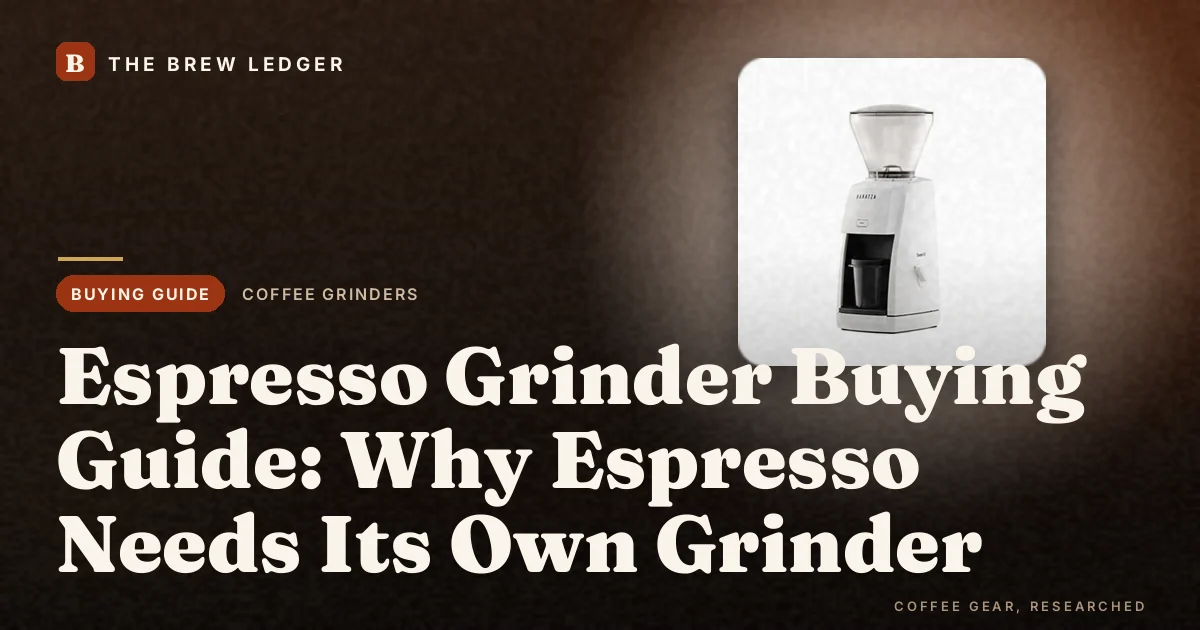
Buy the Eureka Mignon Specialita if you pull daily non-pressurized shots and want the most repeatable dialing; avoid it if you mainly brew filter. Buy the Baratza Encore ESP if you are learning espresso and want a repairable all-rounder; avoid it if you already dial precisely and feel its steps. Buy the 1Zpresso JX-Pro if you want maximum adjustment per dollar and brew for one or two; avoid it if you pull many shots daily. Buy the Fellow Opus if you switch between espresso and filter; avoid it if espresso is daily and you want stepless control. Buy the Timemore C3 ESP if budget is the constraint and you accept manual effort; avoid it if you need 48 mm burr speed.
What to ignore on the spec sheet
Ignore wattage and RPM as quality signals; a slow 1350 RPM motor can out-grind a fast one. Ignore grind setting counts without knowing the step size: 40 fine steps beat 60 coarse ones for espresso. Ignore built-in tampers and other bundled accessories when judging the grind mechanism itself.
Questions, answered
How much should I spend on an espresso grinder?
Enough for fine adjustment matched to your basket: a manual like the C3 ESP or JX-Pro for non-pressurized shots on a budget, the Encore ESP for electric starters, and stepless flat burrs like the Specialita for daily rituals. The under-200 guide maps the value tiers.
Should I upgrade my grinder or my espresso machine first?
The grinder, almost always. Grind quality and adjustment limit shot quality before the machine does, and a good grinder improves every machine it feeds.
Do I need a single-dose grinder for espresso?
Not necessarily. Single-dose shines when you switch beans often; a hopper grinder with timed dosing suits a fixed daily routine. Low retention matters in both cases, which the grind-by-weight guide covers.
When is it time to upgrade my espresso grinder?
When its adjustment steps straddle your ideal shot, when retention muddies your dosing, or when you want the clarity of larger flat burrs. If your shots are inconsistent despite good technique, the grinder is the usual suspect.