In-depth review
Bialetti Moka Express Review: The Stovetop Shortcut to Strong Coffee
In-depth Bialetti Moka Express review: the 1933 stovetop classic on brew strength, sizes, induction limits, and care.
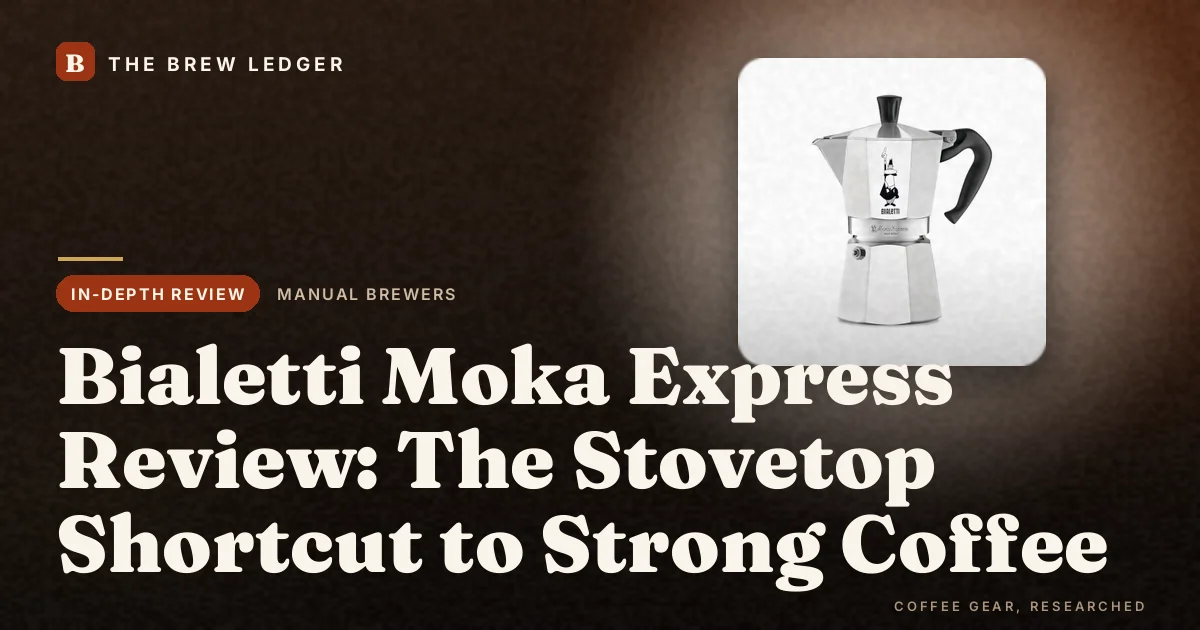

Bialetti Moka Express
The 1933 octagonal icon that defined stovetop coffee.
- Invented: 1933 by Alfonso Bialetti
- Body: Cast aluminum, octagonal
- Sizes: 1, 2, 3, 4, 6, 9, and 12 cups
Our verdict
The Moka Express is the simplest route to strong coffee: fill, heat, pour. No grinder precision, no pouring technique, no filters to buy, and sizes from 1 to 12 cups. The trade-offs are real but narrow: the aluminum body rules out induction cooktops and needs hand washing, and the design offers almost no recipe control. If your priority is a bold morning cup with minimum fuss, it remains unbeaten for the money; if you want to experiment, the AeroPress gives you far more variables. Compare them directly in AeroPress vs moka pot, or see the full AeroPress ranking in best AeroPress picks.
What we like
- In production since 1933 with the same octagonal aluminum design
- Seven sizes from 1 to 12 cups cover solo drinkers to dinner parties
- Steam pressure does the work; no plunging, pouring technique, or filters to buy
- Every gasket and filter plate is replaceable, so pots last decades
What to watch out for
- Aluminum body is not induction-compatible and should be hand washed
- Brew strength is fixed by the design; little room to experiment with recipes
- Leaving it on the heat too long scorches the coffee, the classic beginner mistake
Who it is for
Stovetop coffee drinkers who want a strong, traditional cup with the least possible technique and upkeep.
Brew method and cup quality
Steam pressure pushes hot water up through the coffee basket into the top chamber, producing a strong, heavy-bodied coffee that sits between drip and espresso in intensity. It is not true espresso (a moka pot reaches roughly 1.5 bars versus a pump machine's 9), but for milk drinks and bold black coffee it has satisfied drinkers since 1933.
Sizes and choosing yours
Seven sizes span 1 to 12 cups, where Bialetti's cup is a small 2 oz espresso-style serving. Buy the size matching your usual brew: moka pots perform best filled fully, so a 6-cup pot making 2 cups brews weakly. The 3-cup and 6-cup sizes cover most solo and couple routines.
Heat source and care limits
The cast aluminum body works on gas and electric coil stovetops but not on induction without an adapter plate. Hand washing is recommended: dishwashers dull the aluminum and can leave a metallic taste. The gaskets and filter plates wear out every year or two of daily use, but replacements cost little and every hardware store stocks them.
How it stacks up
Against the AeroPress Original, the Moka Express needs no technique beyond heat and makes stronger coffee, but it offers almost no recipe control, requires a stovetop, and the aluminum body excludes induction; the AeroPress brews anywhere with a kettle and gives a cleaner, more adjustable cup in 1 to 3 cup batches. Against the Bodum Chambord French press (34 oz, glass, 3-part steel filter), the Moka Express produces a more concentrated cup with zero sediment, while the Chambord needs no heat source at all and serves a full pot, trading intensity for body and a silty finish.
Key specifications
- Invented
- 1933 by Alfonso Bialetti
- Body
- Cast aluminum, octagonal
- Sizes
- 1, 2, 3, 4, 6, 9, and 12 cups
- Heat source
- Gas and electric stovetops (not induction)
- Care
- Hand wash recommended
Sources: Bialetti official product specifications, Major retailer product listings, Published coffee gear reviews
What owners report
Owners praise
- Owners praise a design that has stayed in production since 1933, with the same octagonal aluminum shape
- Many owners like having seven sizes from 1 to 12 cups, covering solo drinkers through dinner parties
- Long-term owners say steam pressure does all the work, with no plunging, pouring technique, or filters to buy
Common complaints
- Some owners are frustrated that the aluminum body is not induction-compatible and needs hand washing
- Owners note brew strength is fixed by the design, leaving little room to experiment with recipes
- A common complaint is scorched coffee when the pot is left on the heat too long, a classic beginner mistake
Also consider
AeroPress Original
The 2005 original that turned a tube and a plunger into a brewing icon.
- Designer: Alan Adler (released 2005)
- Capacity: 1 to 3 cups per press
Sources: AeroPress official product specifications, Major retailer product listings, Published coffee gear reviews
Check current price
Bodum Chambord
The chrome-and-glass French press design that has defined the category since the 1950s.
- Design: Iconic French press, dating to the 1950s
- Beaker: Borosilicate glass
Sources: Bodum official product specifications, Major retailer product listings, Published coffee gear reviews
Check current priceResearch-based assessment. TheBrewLedger has not hands-on tested this product; this evaluation synthesizes manufacturer specifications, retailer documentation, and published expert reviews.
Questions, answered
Why does my moka pot coffee taste bitter or burnt?
Almost always heat management: the pot stayed on the burner too long after brewing finished. Pull it off the heat the moment it starts sputtering and gurgling, and run the base under cold water to stop extraction. Also avoid tamping the grounds or grinding too fine.
Can I use the Moka Express on induction?
Not directly; the aluminum body is not magnetic. Use an induction adapter plate, or choose a stainless steel moka pot designed for induction.
What grind should I use?
Medium-fine: finer than drip, coarser than espresso. Fill the basket loosely and level it off; never tamp. Too fine chokes the filter and causes sputtering.
How often should I replace the gasket?
Every 12 to 24 months of daily use, or when you see steam leaking from the sides during brewing. A worn gasket is the most common cause of weak, under-extracted moka coffee.